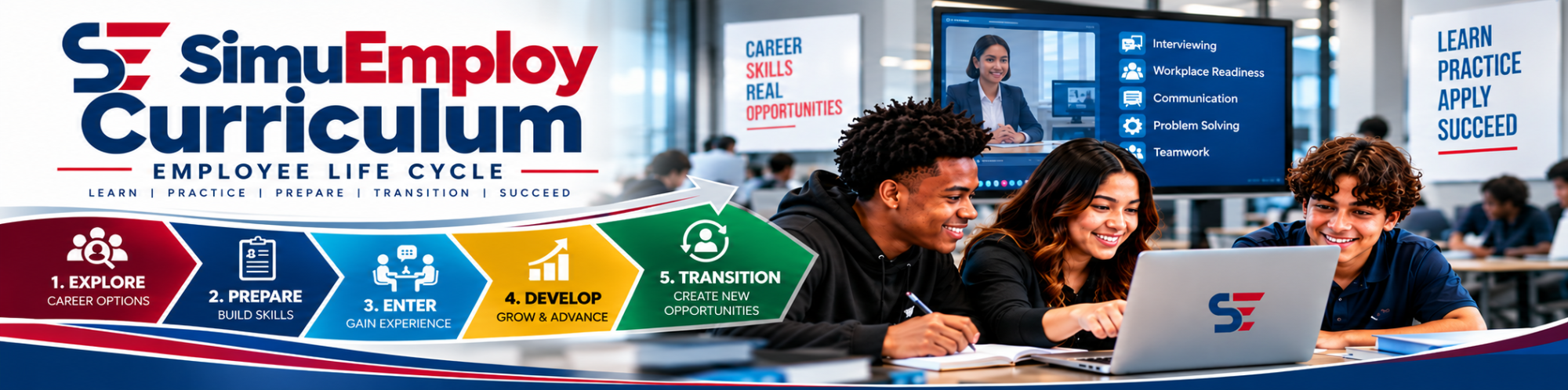
SimuEmploy Curriculum
Learning About the Workforce. Preparing for Employment. Building Skills for Life.
Learning Through the Employee Life Cycle
Career readiness is not a single lesson, skill, or classroom activity. It is a developmental process that requires students to understand themselves, explore opportunities, develop practical competencies, and prepare for the responsibilities of employment.
The SimuEmploy curriculum, developed by Mission Hope Foundation, introduces students to the world of work through a comprehensive instructional framework organized around the Employee Life Cycle. Rather than focusing exclusively on obtaining a job, the curriculum helps students understand the complete employment experience, from career exploration and workforce entry to professional development, workplace performance, employment transitions, and adulthood planning.
Through ten interconnected instructional modules, students explore how organizations function, how employment decisions are made, and how individuals navigate professional responsibilities throughout their working lives.
The goal is simple: Help students understand the workforce before they become part of it.
Where Career Education Meets Practical Application
Learn It. Understand It. Apply It.
SimuEmploy connects career-development instruction with opportunities for practical application. Students first develop foundational knowledge through structured lessons, discussions, activities, and career-development resources. Selected instructional concepts are then reinforced through realistic workforce simulations that allow students to explore situations they may encounter during employment.
This approach encourages students to move beyond memorizing career-related information and begin applying their knowledge through decision-making, communication, problem-solving, and workplace scenarios.
By connecting instruction with experiential learning, SimuEmploy helps students develop a clearer understanding of workplace expectations while strengthening the competencies needed for successful employment transitions.
Explore the Ten Curriculum Modules
Module 1: Introduction to the Workplace
Understanding the World of Work
Students begin by exploring the modern workplace and the factors that influence employment experiences. Instruction introduces workplace dynamics, essential employment skills, labor laws, the historical development of employment practices, diversity and inclusion, and the Employee Life Cycle.
Students develop foundational knowledge of how workplaces operate, how employees contribute to organizational success, and why professionalism and workplace expectations matter.
Module 2: Using Inventories to Prepare for the Workplace
Discovering Personal Strengths and Career Possibilities
Career preparation begins with self-awareness. Students explore their interests, abilities, employment ambitions, learning preferences, interpersonal skills, and potential career pathways.
Through career inventories and guided reflection, students examine how personal characteristics and professional competencies relate to employment opportunities. Instruction also introduces nontraditional career pathways, transferable skills, and the importance of teamwork.
Module 3: Exploring the Attraction Phase
Building a Professional Identity
Students learn how individuals present themselves to potential employers and prepare for career opportunities.
Instruction emphasizes résumé development, cover letters, electronic portfolios, professional online presence, social media etiquette, and interviewing preparation.
Students explore how their experiences, qualifications, and personal presentation influence employment opportunities while developing materials that support future career applications.
Module 4: Exploring the Recruitment Phase
Navigating the Hiring Process
Students examine how employers recruit, screen, and select candidates while learning how to navigate the employment application process.
Topics include identifying income needs, interpreting job descriptions, conducting job searches, understanding applicant tracking systems, and completing employment applications.
Instruction helps students understand both the applicant's responsibilities and the employer's perspective during recruitment.
Module 5: Exploring the Onboarding Phase
Understanding the First Steps of Employment
Receiving a job offer is only the beginning of the employment experience.
Students explore human resources functions, employment offers, pre-employment requirements, onboarding documentation, orientation, organizational governance, compensation, benefits, and employee support programs.
Instruction introduces the processes and expectations that help employees transition into their new roles and become familiar with workplace policies and organizational structures.
Module 6: Exploring the Learning and Development Phase
Growing Beyond the First Day
Professional success requires continuous learning and adaptability.
Students examine workplace training, learning management systems, career ladders, professional development opportunities, employee contributions, and organizational policies.
Instruction emphasizes the relationship between skill development, employee growth, organizational expectations, and long-term career advancement.
Module 7: Exploring the Performance Management Phase
Building Accountability and Professional Responsibility
Students explore how employers communicate expectations, evaluate employee performance, and address workplace challenges.
Topics include chain of command, professional communication, goal setting, performance evaluations, improvement plans, disciplinary processes, employee grievances, conflict resolution, and workplace culture.
Through workplace examples and guided activities, students develop a greater understanding of accountability, professional conduct, and the importance of responding constructively to workplace feedback.
Module 8: Exploring the Retention Phase
Understanding Employee Success and Workplace Stability
Maintaining employment involves more than completing assigned responsibilities.
Students explore the factors that influence employee satisfaction, professional growth, and long-term workplace participation.
Instruction includes employee wellness, work-life balance, recognition, mentorship, performance-based compensation, promotions, demotions, and opportunities for advancement.
Students examine how employees and organizations share responsibility for supporting productive and sustainable employment experiences.
Module 9: Exploring the Separation Phase
Navigating Employment Changes Professionally
Employment relationships may change for many reasons, including career advancement, transfers, resignation, and organizational decisions.
Students explore employment separation, professional transitions, references, networking, and appropriate procedures for leaving a position.
Instruction emphasizes maintaining professional relationships, understanding workplace responsibilities, and preparing for future opportunities during employment transitions.
Module 10: Transition into Adulthood Planning
Connecting Career Readiness With Life Readiness
The final module connects workforce preparation with the broader responsibilities associated with adulthood and independent living.
Students explore transition planning, school-to-work resources, budgeting, personal finances, employment goals, postsecondary education, and occupational training opportunities.
Instruction encourages students to connect their educational experiences, career interests, and personal goals with realistic plans for life beyond high school.
A Curriculum Built Around Career-Readiness Competencies
SimuEmploy emphasizes transferable knowledge and competencies that students can apply across occupations, industries, and geographic locations.
The curriculum addresses professional communication, career exploration, employment preparation, workplace technology, critical thinking, decision-making, accountability, and professional development.
Its competency-based structure provides a foundation for connecting instructional activities with applicable state and federal educational standards while preserving a consistent approach to career development.
This flexibility allows educators to incorporate SimuEmploy into different instructional settings without limiting the curriculum to a single state's learning standards.
Supporting Educators and Workforce Development Programs
Flexible Instruction. Meaningful Learning. Practical Application.
SimuEmploy is designed to complement career-development instruction in high schools, career and technical education programs, after-school initiatives, and workforce development settings.
Educators can use the curriculum to introduce career-readiness concepts, reinforce classroom instruction, facilitate discussions, guide career-development activities, and connect selected lessons with workforce simulations.
The ten-module structure also provides an organized framework for identifying instructional priorities and connecting career preparation with broader educational and workforce-development objectives.
Connecting Instruction With Assessment
Understanding Knowledge. Identifying Growth. Strengthening Instruction.
Career-readiness instruction is most valuable when educators can identify what participants understand and where additional learning may be needed.
SimuEmploy's Career Fundamentals Assessment System (CFAS) is designed to support the evaluation of career-readiness knowledge and competencies through pre- and post-assessment.
Assessment findings can help schools and programs identify learning needs, examine changes in participant knowledge, and inform future instructional planning.
Together, curriculum instruction, practical application, and competency-based assessment provide a framework for strengthening career-development programming.
Preparing Students for More Than Their First Job
The transition from education into employment represents an important milestone, but career readiness extends far beyond securing an initial position.
Students must also understand workplace relationships, professional expectations, organizational systems, employee development, and the decisions that shape their employment experiences.
By introducing these concepts before students enter the workforce, SimuEmploy helps make career preparation more relevant, practical, and connected to the realities of employment.
SimuEmploy: Preparing Students for the Workforce by Helping Them Understand the Entire Employment Journey.
